Indonesia's Amolek Area: GreenZyme Well Stimulation Results

Updated: Aug 23
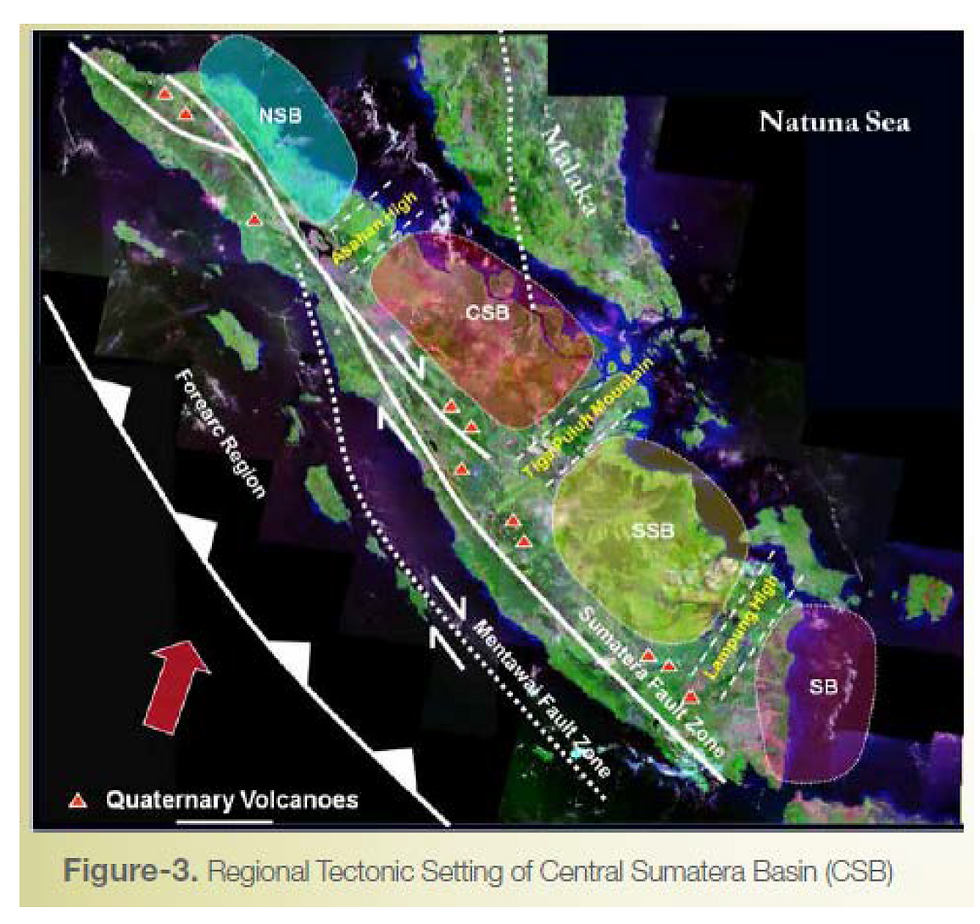
A 2008 field case study from the Amolek Area, Central Sumatra Basin, Indonesia, examines GreenZyme's effect on declining oil production caused by permeability and wettability changes in the reservoir.
The Amolek Area sits within Indonesia's Central Sumatra Basin, one of the country's most prolific onshore oil basins. Like many mature fields in the region, its wells have seen declining production over time as formation damage and unfavorable wettability changes reduce the flow of oil toward the wellbore.
Declining oil production is a long-standing problem in the oil and gas industry. This decline can be caused by reduced permeability around the wellbore due to formation damage. Well stimulation operations are designed to increase production rate and improve fluid movement within a reservoir.
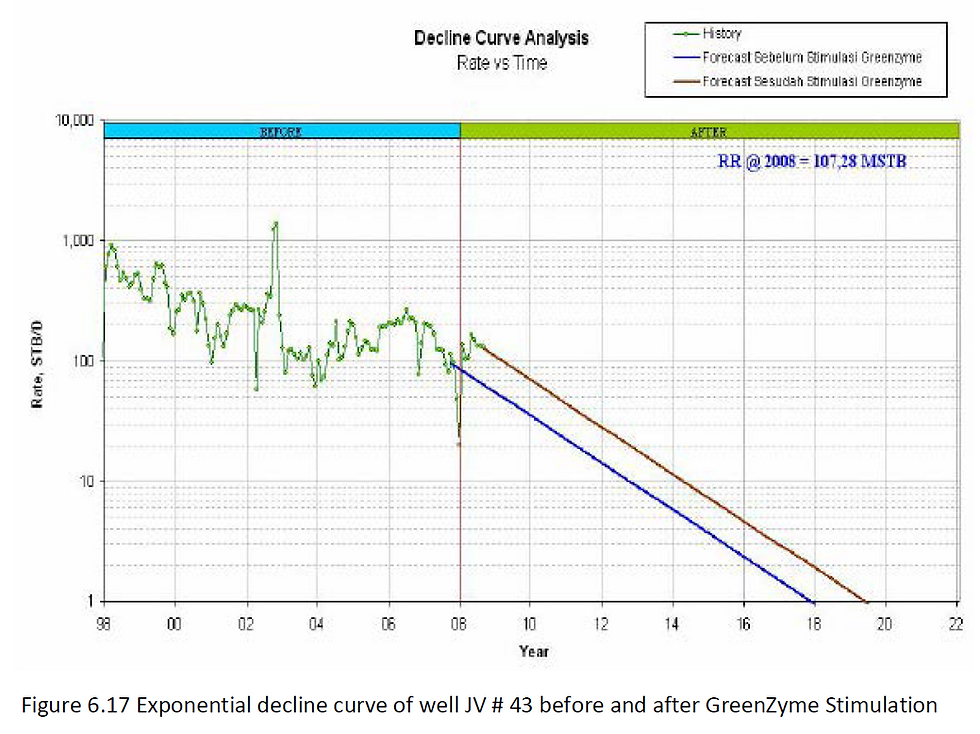
Performance of Well JV#43 before and after GreenZyme stimulation
Well stimulation can generally be done in two ways: matrix stimulation (acidizing) and hydraulic stimulation (fracturing). GreenZyme stimulation, by contrast, is a newer technology that can increase production rate and oil recovery through an operation that is simpler and more cost-effective than acidizing.
GreenZyme is a water-soluble, protein-based biological enzyme — a non-living catalyst rather than a living microorganism. It works by catalytically releasing oil from sand grain surfaces and altering wettability, changing an oil-wet surface to a GreenZyme-protected, water-wet surface, which mobilizes oil from the reservoir toward the wellbore.

The Amolek Area pilot covered three fields: one well in Field J, five wells in Field JV, and two wells in Field V. Well JV#43 saw the most significant increase, rising from 20 to 146 BOPD, and Well JV#14 delivered the strongest cumulative result, with an incremental recovery of 926.16 MSTB (thousand stock-tank barrels) of oil.
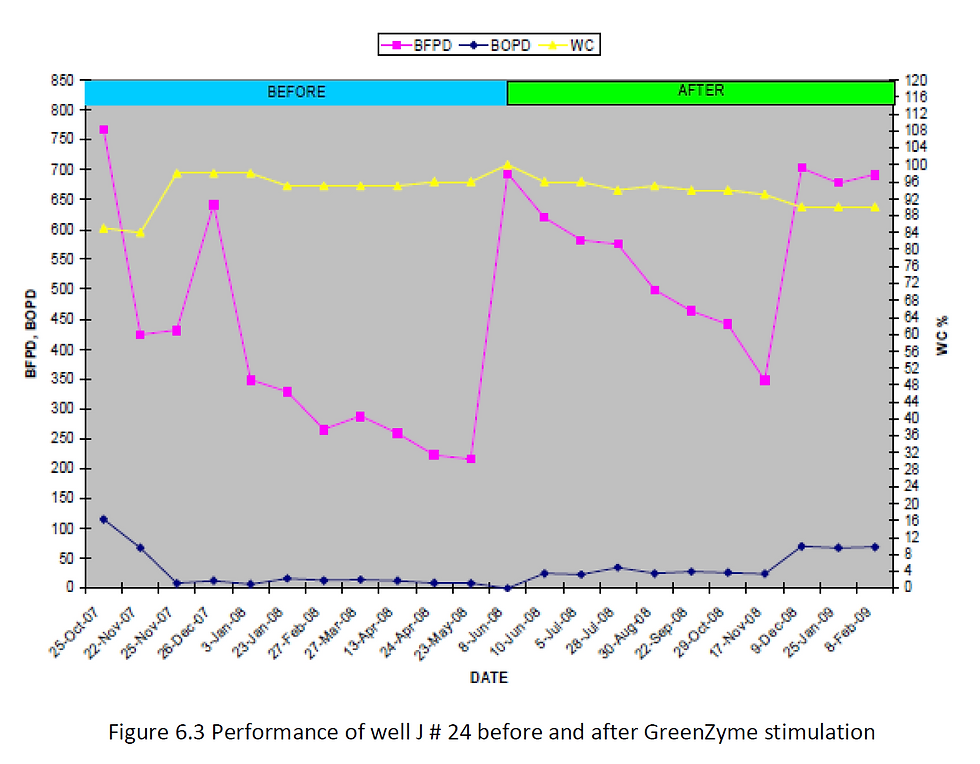
Across the full pilot of 8 wells in the Amolek Area, GreenZyme stimulation increased production in 6 of 8 wells — a 75% success rate. The 2 unsuccessful treatments did not meet the well-selection criteria; one of the two was a dead well, no longer producing, that GreenZyme was used to attempt to restart. In this case, GreenZyme is not responsible for re-starting a dead/capped or non-producing well. The well must be started and proven to be in sustained production for a period of time to ensure its capability to produce (example: 2 weeks) for it to be a candidate to receive a treatment.
Editorial note: This case study documents GreenZyme stimulation work conducted in the Amolek Area, Central Sumatra Basin, Indonesia, in 2008, as reported in the university thesis cited below, published online in January 2010.
Sources & Credits
Virgo, J. (2008). Evaluation of Production with GreenZyme Stimulation in the “Amolek” Area, Central Sumatra Basin [Undergraduate thesis]. Published online, January 2010.


