Suriname's Tambaredjo Field: A Different Kind of GreenZyme Result

Updated: Aug 18
GreenZyme®'s clearest measurable result in Suriname's Tambaredjo field wasn't a bigger oil rate — it was a lasting drop in water-in-oil emulsion.
Staatsolie's Tambaredjo field, on Suriname's coastal plain, shares a problem common to mature onshore fields worldwide: wells start producing water very early, often reaching water cuts of 90% within a few years, leaving significant oil behind. In 2019, Staatsolie contracted BTP GreenZyme® for a pilot to evaluate whether enzyme injection could change that picture in a set of vertical T-sand producers.
After a multi-year candidate screening process, four wells were treated in November 2020: 3Q01, 30NH23, 3G13, and 3F16. What makes this case study different from most is what Staatsolie actually measures as success. For this operator, the priority isn't oil-rate uplift on its own — it's water-in-oil emulsion behavior at the wellhead and in the facilities. A treatment that reduces emulsion complications is, by their own evaluation criteria, a win in itself, independent of how much extra oil comes with it.
The Result: A Sustained Drop in Emulsion BS&W
On well 30NH23, emulsion BS&W — the bottom sediment and water content measured in a settled oil sample — averaged 18–21% for nearly two years before treatment. After the GreenZyme® injection, it dropped to roughly 5–10% and held there for over a year of follow-up monitoring. The before-and-after ranges don't overlap, which is the kind of clean, sustained separation that points to a real mechanism at work rather than normal field noise: lower interfacial tension between oil and water, and a rock surface the enzyme has made less willing to hold onto both phases at once. Oil polishing begins in the reservoir.
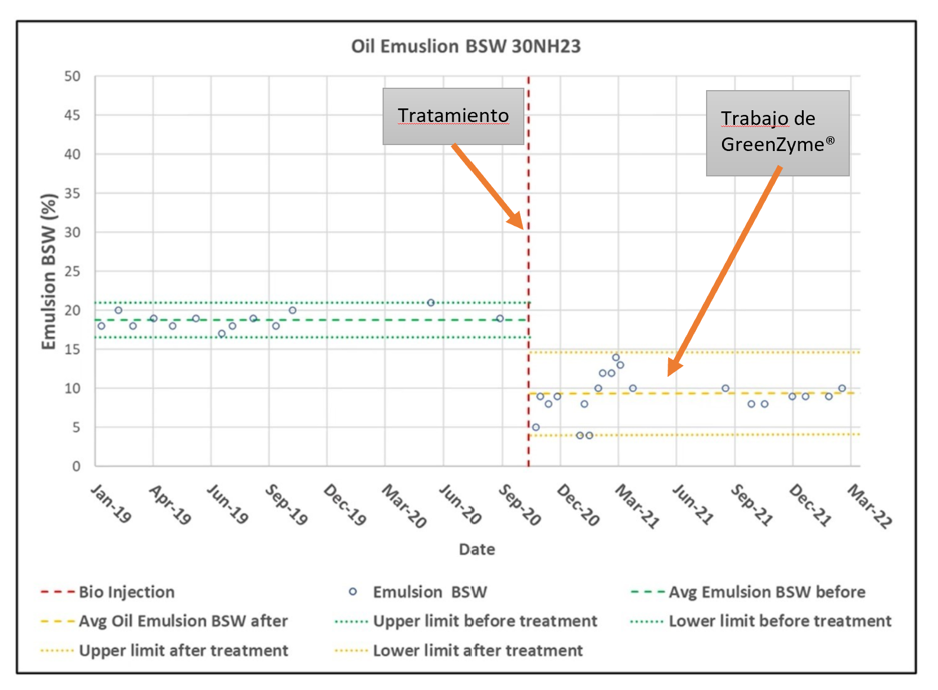
That result held up under a formal joint review roughly 21 months after treatment, when Staatsolie and BTP scored all four wells against six criteria covering emulsion behavior, water salinity, productivity, and incremental oil. 30NH23 and 3Q01 both scored positively on emulsion reduction; taken together with other positive markers, 3Q01 came out as the strongest overall performer of the four — notable, since it had been flagged as a marginal candidate during pre-treatment screening, not an obvious pick for success.
On Oil Rate: An Honest Picture
Oil rate across the four wells was mixed, and it's worth saying so plainly. 30NH23, the strongest producer of the group before treatment, saw its rate fall afterward — a change the field team traced to a pump-speed adjustment made after the well was brought back online, rather than to the treatment itself. The other three wells were flat to modestly positive on rate.
Sources & Credits
Simons, S. (2019). Feasibility of the injection of a biological enzyme to increase well productivity in the Tambaredjo field [Master's thesis]. Anton de Kom University of Suriname. Simons led candidate selection and project coordination on Staatsolie's side from 2018 through the 2020 treatment program.


